As I wrote in the Korea Times, citing Paul Fussell, there are three kinds of people who travel:
Tourists, travelers, and explorers. Briefly, tourists stick to the familiar. Travelers get somewhat involved in the local culture. Explorers dive right in, often “going native.” (I confess to being a traveler. I have been mistaken as being an explorer, although “unorganized” is more accurate.)
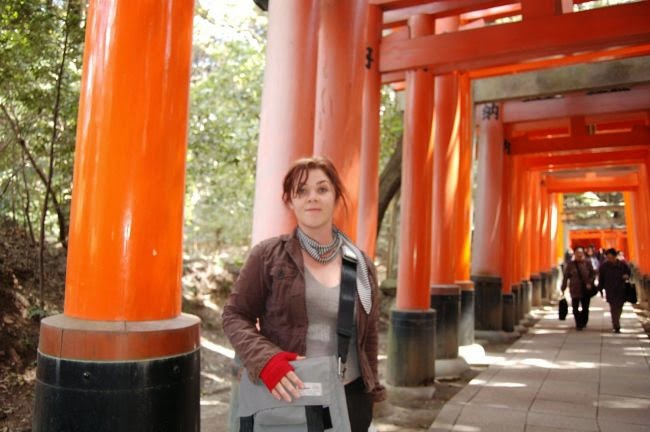 |
| Travel writer Amy Gray |
They are talking about explorers. Tourists wouldn't know how to travel alone--at least, not for long! They'd be on the phone, threatening their tour guides for putting them in danger.
Travelers may give it a try, but the idea of just going it alone, bouncing around, doesn't provide them with enough structure.
* * *
 In a commentary in yesterday's Korea Times, Shomi Kim reminds us that Korea is the first country to go from being an aid recipient to an aid giving nation, and she also notes that Korea has had the highest increase of giving among the members of the Development Assistance Committee. She then says this "leads to an obvious question: Does this reflect the growth of Korean people’s interest in international development issues?"
Well, that is not my obvious question. Instead, my obvious questions:
1) Was foreign aid a good thing for Korea? Based on what I have read in the past, Korea's economy didn't start to grow until its economy was opened. So if countries want to follow Korea's lead, then getting off (foreign aid would seem to be important and a better model).
2) Does giving foreign aid really help those countries that are recipients of Korea's aid today?
3) Instead of aid, could it be that trade would be better for those recipients?
* * *\

He was joking around during the off-season, saying that if he suffered from "Manziel Disease," that he wanted reporters to hit him in the head with a microphone.
Last year's Heisman winner, Johnny Manziel, is a crazy guy, but he doesn't have possible rape charges. The Heisman voters will be voting soon, his possible court case hasn't been resolved. That means, at least this year, I have a better chance of winning the Heisman than he does.
Update: Winston won't be charged. He is, once again, favored to win the Heisman.
* * *
Pride
One interesting thing about living in in Korea is hearing how often Koreans take pride in some unimportant things. The latest:
A study published in a journal about a Korean coffee shop.
“I’m proud, as a Korean, that the thesis was selected,” said Kim Sun-kwon, the chief executive and founder of Caffbene. “We’ll continue to work to improve our services and quality to become a global brand.”On the other hand, what do the folks at the Korea Times who, last year wrote "Just too many coffee shops around," feel about that?
And, by the way, how is the name of the business spelled? In the Korea Herald, it is Caffbene, but on the actual business, it is Caffe Bene..

Casey
Linked by Aaron McKenzie
Aaron McKenzie makes several great points and adds some great data. In particular, I like this:
Our average South Korean need not take an explicit “interest in international development issues” in order to actually bring about an improvement in the material well-being of her counterpart in the developing world. When a Samsung engineer cooperates with his colleague in India, or when an SK executive finalizes an agreement to build a new road in Africa, they are contributing to international development, even if this is not their goal. That their efforts are not funneled through the World Bank, the ADB, or the DAC, makes them no less effective (indeed, they're probably more effective).Brilliant...
And from Don Boudreaux at Cafe Hayek a few days ago, he notes the New York Times in 2011 used the phrase "United Nations assembly of parts." Great! But that runs counter to the development specialists out there who want to talk about how to increase development through their 5 year plans, while business people, when they don't have barriers thrown in front of them, are already doing what the development specialists and politicians dream of and talk about...
Prof. Boudreaux was responding to a book review about Benjamin Barber's political hero fantasy "If Mayors Ruled the World."
Prof. Boudreaux notes:
Even the most commonplace items that we consume in modern society are the results of the creativity, risk taking, and efforts of literally millions of people from around the world. The computer that Mr. Barber used to write his book was likely designed in California and assembled in Suzhou, China, from raw materials and parts transported from the Americas, Africa, and Europe on vehicles built in Germany, Japan, Norway, South Korea, and the U.S. Financing and insurance for this globe-spanning supply chain were supplied by investors and institutions from Seattle to Sydney, Lima to London, and Melbourne to Montreal.
Politicians and development specialists keep dreaming about a world that is being made without them, and one they can't take credit for...